
Your Charleston CME conference.
Your dates. Your specialty. We handle everything else.
Check in once for the entire trip.
Seamless, start to finish.
A personalized live conference. One-click check-in from your email. Automatic checkout when the conference ends. Documents generated automatically.
See how it worksThe check-in area
Check in within 20 miles of the designated center.
Unbeatable value. From under $50 a day.
One fee, $349, for a single conference of up to 7 days. Annual membership for multiple trips at the lowest cost per day.
Compare plans

From under $50 per study day
Plus applicable tax.
Make this trip yours.
$349 one time with Lite
One personalized conference in Charleston. Choose 1–7 study days for the same price.
Plus applicable tax.
Make room for more.
Membership: $999 a year
21 study days to use across your conferences throughout the year. Choose a new destination, new dates and a personalized program for each trip.
Renews annually; plus applicable tax.
Documentation, done for you.
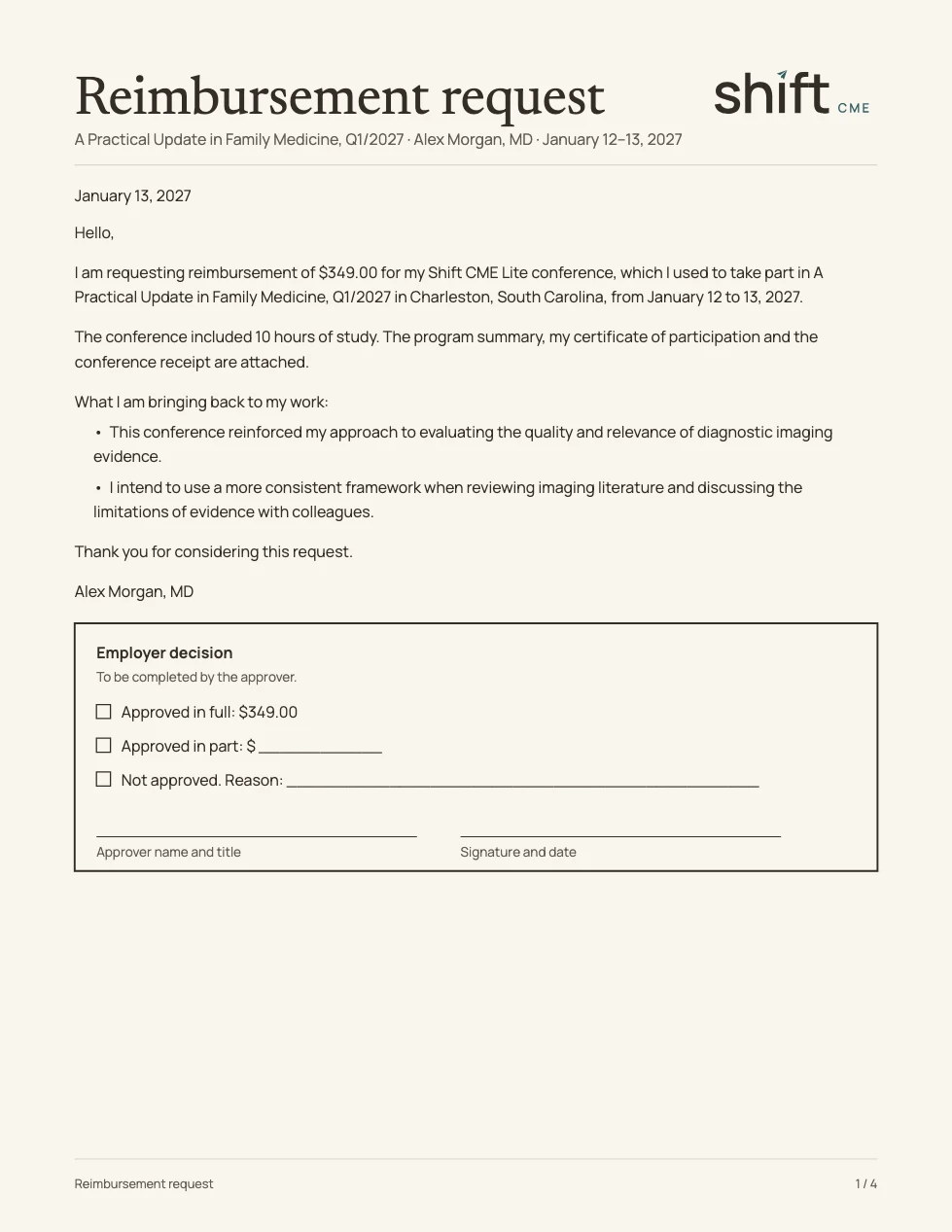
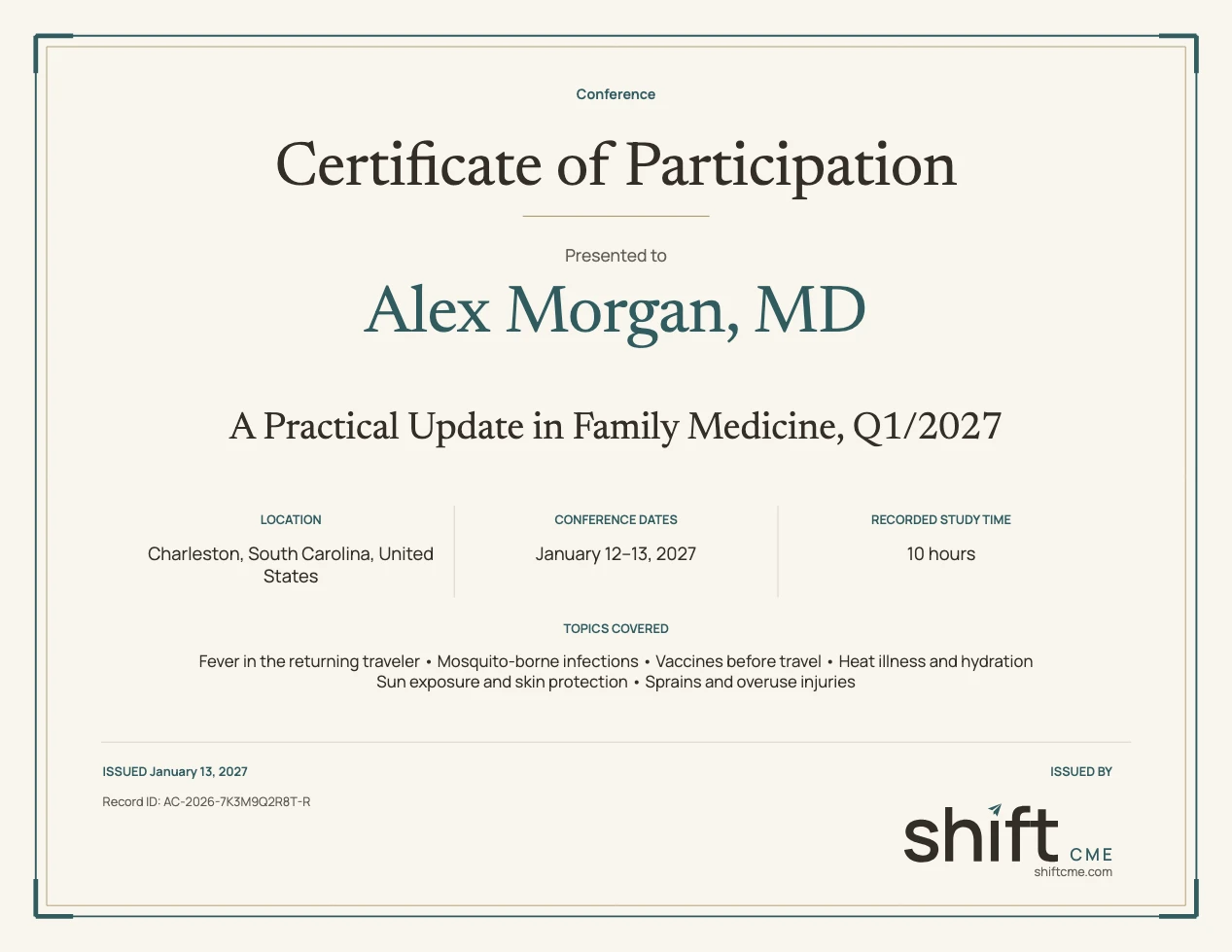
Itinerary, certificate, reimbursement letter. In your inbox. Tax-ready.
Credit options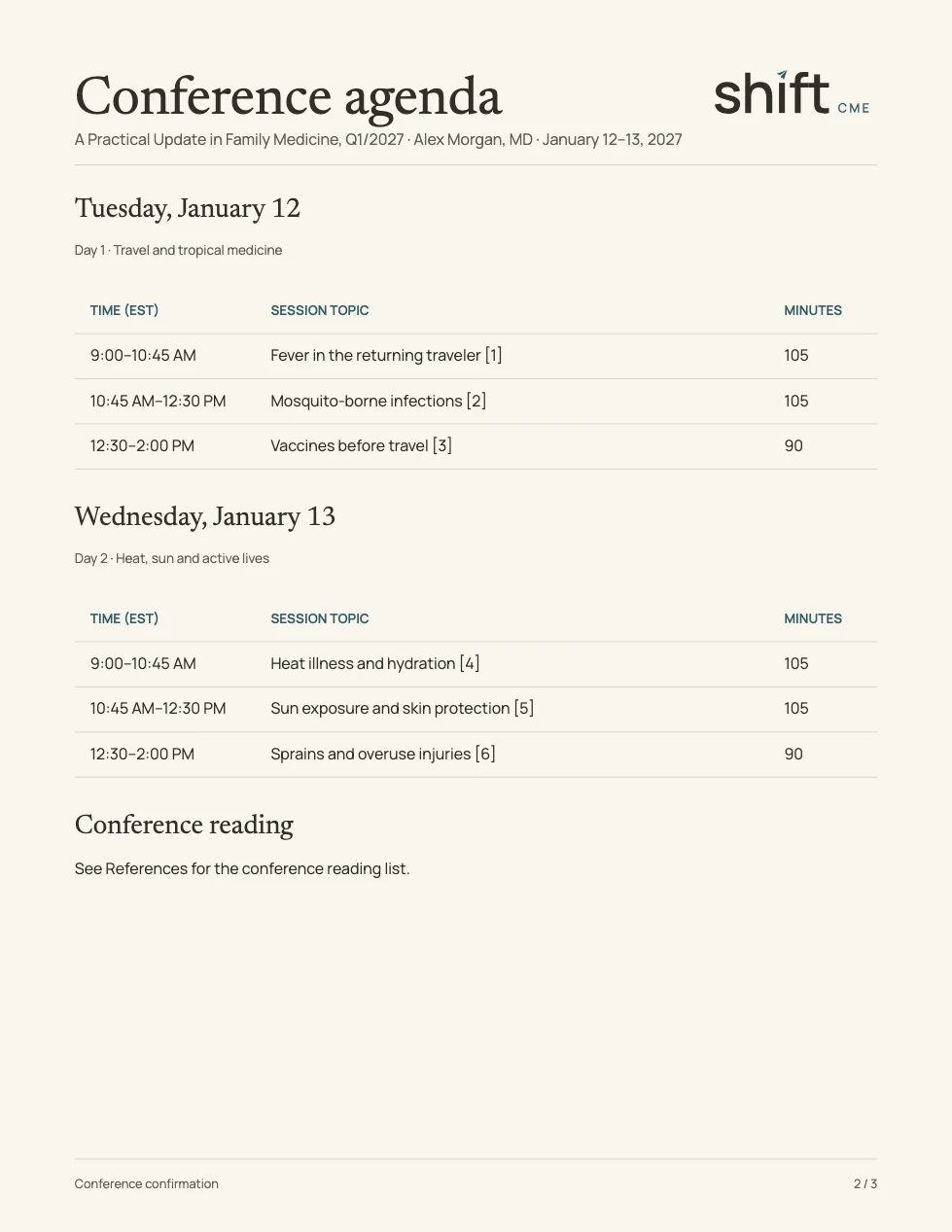
Shift CMEToday
Your Charleston conference documents
Built around your practice.
Personalized live conferences with relevant materials.
Your conference
Charleston
Live today · 9:00 AM – 2:00 PM
Day 1 · Travel and tropical medicine
- Fever in the returning traveler
- Mosquito-borne infections
- Vaccines before travel
The details.
Planning Charleston
How it works, step by step
Choose your dates and specialty.
Make Charleston your setting. Start any day of the year and choose 1–7 consecutive study days.
Review your personal program.
We build it from presentations and journal modules for your specialty. Swap or remove sessions before you confirm.
Go, check in and learn.
Check in once from your phone within 20 miles of the designated center. Study at your destination, then make the afternoon your own. See the Charleston check-in area.
Watch the full How Shift works videoExplore the full three-day primary-care sample
Your program draws on licensed educational content. Presentations pair audio with slides; journal modules link to source readings.
Sample 3-day conference in Charleston
IllustrativeSAMPLE CONFERENCE
A practical update in primary care
Tue 12 – Thu 14 Jan 2027 · 3 study days · 9:00 AM–2:00 PM Eastern Time
Day 1 · Tue 12 JanTravel and tropical medicine
- 9:00–10:30 AMPresentationFever in the returning travelerAudio and slides at its scheduled time
- 10:30 AM–12:00 PMPresentationMosquito-borne infectionsAudio and slides at its scheduled time
- 12:00–2:00 PMJournal moduleVaccines before travelRead at its PubMed Central link
Day 2 · Wed 13 JanHeat, sun and active lives
- 9:00–10:30 AMPresentationHeat illness and hydrationAudio and slides at its scheduled time
- 10:30 AM–12:00 PMPresentationSun exposure and skin protectionAudio and slides at its scheduled time
- 12:00–2:00 PMPresentationSprains and overuse injuriesAudio and slides at its scheduled time
Day 3 · Thu 14 JanSleep and fatigue
- 9:00–10:30 AMPresentationInsomnia and sleep habitsAudio and slides at its scheduled time
- 10:30 AM–12:00 PMJournal moduleShift work and the body clockRead at its PubMed Central link
- 12:00–2:00 PMPresentationDaytime sleepinessAudio and slides at its scheduled time
Checked in 9:04 AM · location verified within 20 miles
This is a sample program. Review your available topics and formats before you confirm.
Credit options
Category 1 through a session’s accredited provider, where offered.
Category 2 self-claimed by eligible physicians for qualifying learning.
It depends on the session. A presentation or journal module offers AMA PRA Category 1 Credit™ only where its accredited provider offers a CME activity and supplies instructions for claiming it; then you claim it as that provider directs. That credit comes from the provider, not from Shift CME, and not every session offers it. Physicians may also self-claim AMA PRA Category 2 Credit™ for learning they judge meets the AMA's requirements, and your Shift CME records can support that claim. Nurse practitioners and physician assistants follow their own certifying bodies' rules: NCCPA lets PAs self-claim Category 2 CME, while AANPCB and ANCC require accredited contact hours, which Shift CME does not award.
Where to stay in Charleston
From the cobblestones and painted row houses of the downtown peninsula to barrier-island beaches and a live oak on Johns Island, Charleston mixes history and coast for the hours outside study.
- Downtown Charleston
- Choose this area for walking to the market, Rainbow Row and the Battery.
- Isle of Palms and Folly Beach
- Choose these areas if beach time matters more than museums. Explore Charleston lists beach resort lodging alongside its beach communities.
Afternoons, travel and weather in Charleston
Spring and fall are mild, summers are warm with passing afternoon thunderstorms, and winters are typically mild with some rain. Conferences are available all year.
Charleston after your study day
Study days finish at 2:00 PM Charleston time. Explore Charleston suggests a stroll down East Bay Street to Rainbow Row, a lineup of Colonial-era town houses, and on to the Battery at the tip of the peninsula. Joe Riley Waterfront Park has a large pineapple sculpture, a symbol of hospitality. Explore Charleston’s itinerary describes the Battery as a promenade lined with antebellum homes on one side and Charleston Harbor on the other. Leave time for summer heat and afternoon thunderstorms, and keep an indoor option ready.
Travel, lodging and attraction entry are arranged on your own. The city is the setting for a study day you run yourself, so choose one outing per afternoon rather than trying to cover the whole peninsula.
Streets for a slow walk
Explore Charleston describes Broad Street as Gallery Row, with about 15 galleries and roughly two dozen more on nearby streets. Chalmers Street is one of only eight remaining cobblestone streets in the city, and the Old Slave Mart Museum is there. Church Street has the Dock Street Theatre, described as the nation’s first permanent playhouse, and St. Philip’s Episcopal Church, built in 1835–1838. Its churchyard holds the graves of John C. Calhoun, Edward Rutledge, Charles Pinckney and DuBose Heyward.
King Street is the shopping street: lower King is an antiques district and upper King is a contemporary design district. Tradd and Legare streets are described for their gardens, piazzas and carriage lanterns. Check any museum’s open days against your 2:00 PM finish.
The City Market
Market Hall and the open-air sheds sit on Market Street between Meeting and East Bay Streets. The National Park Service calls the complex a National Historic Landmark and the only surviving market buildings in Charleston. The Pinckney family donated the land in 1788, and the present buildings date from 1840–41, after a fire in 1838.
The Greek Revival hall has a portico of Tuscan columns, and the sheds behind it hold individual vendors selling Low Country arts and crafts. Explore Charleston points to the market for souvenirs such as sweetgrass baskets. Explore Charleston also lists the Charleston Farmers Market among its events, running April through December; confirm the day and location before you go. Vendor lineups change, so treat the market as a browse rather than a shopping list.
Harbor forts and the water
Two forts guard the entrance to Charleston Harbor. Fort Sumter sits on an island and, according to the National Park Service, can be reached only by the concession-operated ferry from Fort Sumter Tours; ferry tickets can be bought in advance. The park describes it as the place where the Confederacy fired on the U.S. garrison on April 12, 1861, opening the Civil War. Check the ferry schedule against your 2:00 PM finish before you plan the afternoon.
Fort Moultrie is on Sullivan’s Island and has 171 years of seacoast defense history and began as a palmetto log fort, where patriots defeated the Royal Navy in 1776. For time on the water, Explore Charleston lists harbor cruises aboard Schooner Pride, an 84-foot, three-masted wooden schooner that sails past Civil War landmarks and barrier islands.
Beaches, an old oak and the plantations
Explore Charleston names Isle of Palms, Sullivan’s Island, Folly Beach, Kiawah and Seabrook among the area’s beach communities. Explore Charleston also lists the South Carolina Aquarium among its attractions, a possible indoor choice for a rainy afternoon. Charleston County Parks notes that its beach parks see more visitors during spring break and warmer weather, so an arrival after your study day may mean sharing the sand.
Angel Oak is a southern live oak at 3688 Angel Oak Road on Johns Island, estimated at 300 to 400 years old, about 65 feet tall and shading roughly 17,000 square feet. The city’s park around it has a picnic area, is open seven days a week and closes on holidays. Discover South Carolina puts it about 12 miles from downtown. Explore Charleston also lists Middleton Place, Boone Hall and Magnolia Plantation and Gardens for landscaped grounds; confirm each site’s days and entry arrangements before you go.
When to visit Charleston
Explore Charleston describes a subtropical climate with about 230 days of sunshine a year. Spring runs from early March into early June, with temperatures from 58 to 72 degrees Fahrenheit and azaleas and dogwoods in bloom. Summer averages 78 to 82 degrees, with coastal breezes and passing afternoon thunderstorms. Autumn runs 58 to 76 degrees with clear skies, and winter averages 47 to 52 degrees, with a chance of snow flurries in late December or early January. Check the forecast before planning outdoor time.
Getting to Charleston and your study setting
Charleston International Airport (CHS) is at 5500 International Blvd. in North Charleston. Its website lists rental cars, parking and ground transportation. The downtown peninsula, the barrier-island beaches and Johns Island are separate parts of the area, so choose accommodation with your afternoon plans in mind.
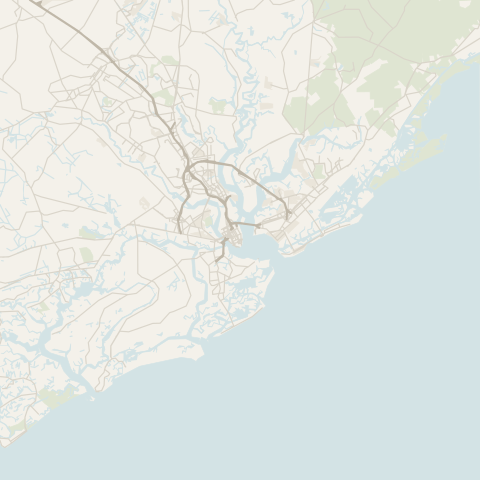
The map shows straight-line distances from Shift’s designated center. These are orientation distances, not driving distances or travel-time estimates. Check your exact address against the conference’s check-in area before booking.
- Destination
- Charleston, South Carolina
- Milder travel season
- March–May · September–November
- Arrival airport
- Charleston International Airport · CHS
- Check-in area
- Within 20 miles of the center
Weather guidance helps you choose a travel season. Shift conferences are available all year.
Sources & local details
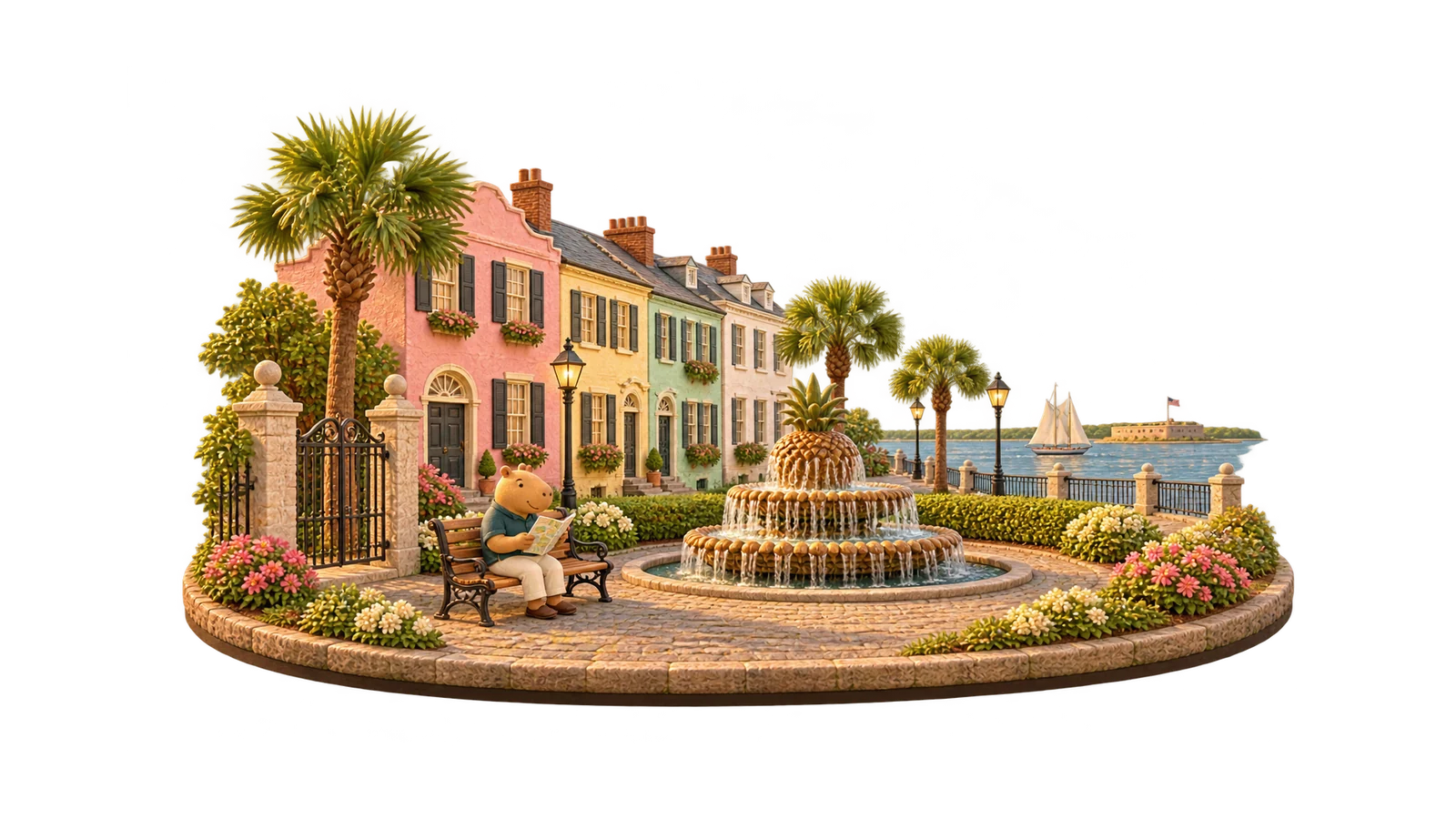
Local guidance by Shift CME, with official sources and individual review dates below. Confirm opening hours, transport and admission directly before booking. The diorama is an illustration, not a venue or included attraction.
- Explore Charleston · Area overviewChecked
- Explore Charleston · WeatherChecked
- Explore Charleston · Eight streets to exploreChecked
- Explore Charleston · A perfect day downtownChecked
- Explore Charleston · 24 hours in CharlestonChecked
- National Park Service · Market Hall and ShedsChecked
- National Park Service · Fort Sumter and Fort MoultrieChecked
- National Park Service · Plan your visit to Fort SumterChecked
- City of Charleston · Angel OakChecked
- Discover South Carolina · Angel OakChecked
- Charleston County Parks · Parks overviewChecked
- Charleston International Airport · HomeChecked
FAQ
How does a conference work?
Choose your destination, dates and specialty. Your program includes journal modules and scheduled presentations. Presentations start at their scheduled times, rather than on demand. Review the program before you confirm. See each step.
Why do I need to be at the destination?
Shift CME licenses educational content for live conferences at designated destinations. Those licenses restrict use to the conference location, so you need to be at your selected destination to participate. Presentations start at their scheduled times as part of your personalized program.
Where do I need to check in?
Select a destination from the destinations page. Check in once during your conference, within 20 miles of the destination’s designated center. Check-in is open from 6:00 AM to 10:00 PM destination time on any study day. If you haven’t checked in by 10:00 PM on your last study day, no participation is recorded. Enable browser location access; if your phone can’t confirm your location, you can confirm it yourself when you check in.
How long is a study day?
Study days run from 9:00 AM to 2:00 PM local time, with presentations starting at scheduled times. That leaves the rest of the day to enjoy your destination.
What does it cost?
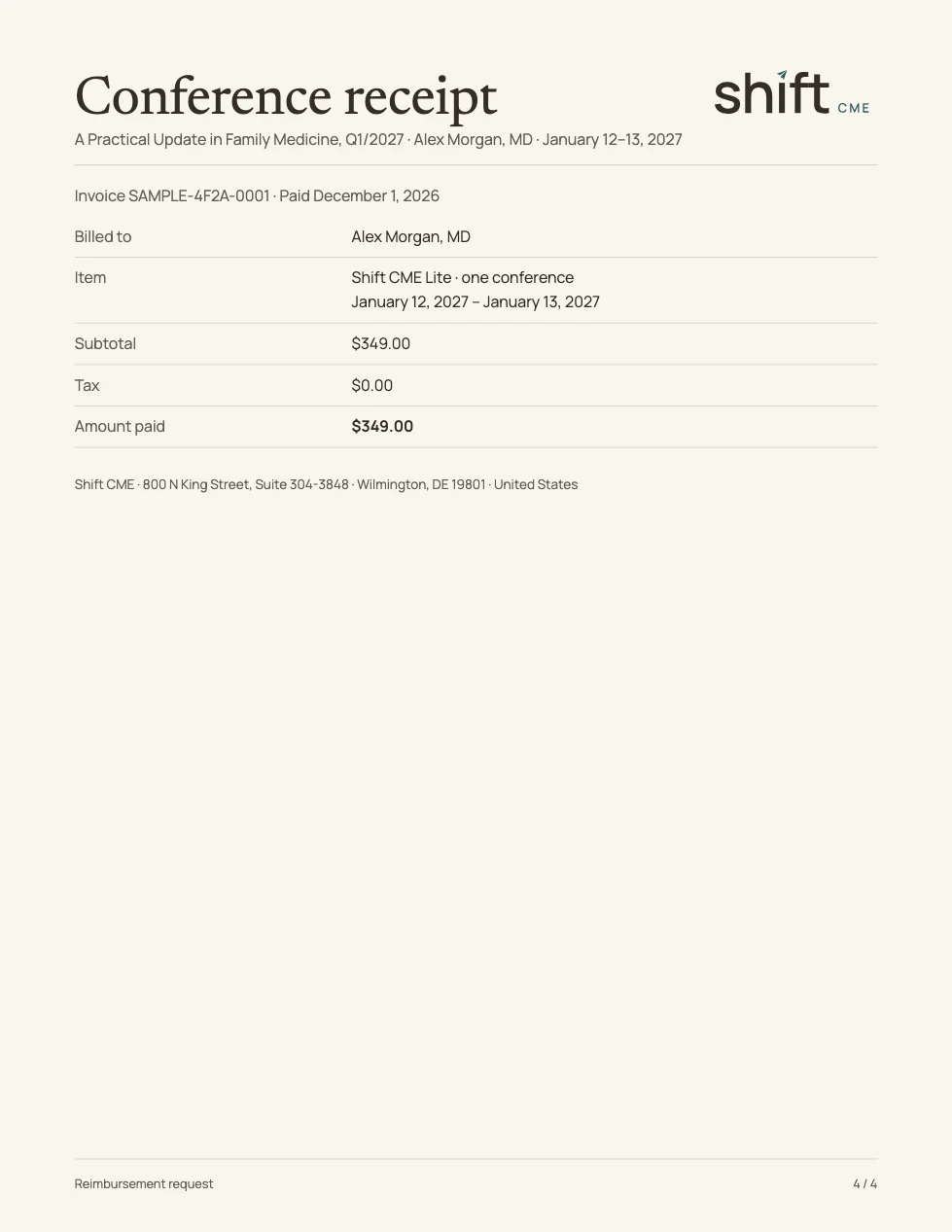
Membership is $999 a year (introductory price), plus applicable tax, and renews at $999 a year until you cancel. It includes 21 conference days a year. Each conference uses 1 to 7 conference days. Members can add days for $40 each. Without a membership, one conference of up to 7 study days is $349, paid before you create it. Read about membership.
Can I change a confirmed conference?
Before you confirm, you can swap or remove sessions, or regenerate the plan. Choosing Confirm and lock itinerary locks the program. To change it after that, cancel the conference and plan a new one. Cancelled or incomplete confirmed conferences keep their confirmation.
 Orlando
 New York City
 Chicago
 Atlanta
 Philadelphia
 Phoenix
 Las Vegas
 San Diego
 Minneapolis
 Washington, D.C.
 San Francisco
 Austin
 Baltimore
 Tampa
 Miami / Miami Beach
 Boston
 Houston
 Seattle
 Pittsburgh
 St. Louis
 New Orleans
 Myrtle Beach
 Denver
 Nashville
 Virginia Beach
 Savannah
 Palm Springs
 Great Smoky Mountains National Park
 Adirondacks
 Scottsdale / Phoenix
 Portland, Oregon
 Ocean City, Maryland
 Santa Barbara
 Santa Monica / Los Angeles
 Gulf Shores
 Galveston
 Laguna Beach / Orange County
 Honolulu (Waikiki)
 Oahu – North Shore
 Catskill Mountains
 Cape Cod
 Zion National Park
 Grand Canyon National Park
 Monterey
 Yellowstone National Park
 Bend
 Destin
 Rocky Mountain National Park
 Yosemite National Park
 Michigan's Upper Peninsula
 Acadia National Park
 Napa Valley
 Olympic National Park
 Grand Teton National Park
 Traverse City
 Newport, Rhode Island
 Glacier National Park
 North Lake Tahoe (Truckee)
 South Lake Tahoe
 Sedona
 Canyonlands National Park / Island in the Sky
 Key West
 Seaside/30A
 Joshua Tree National Park
 Hilton Head Island
 Outer Banks
 Big Sur
 Door County
 San Juan, Puerto Rico
 Bryce Canyon National Park
 Hot Springs National Park
 Maui – Kaanapali
 Maui – Wailea
 Texas Hill Country
 Coronado / San Diego
 Columbia River Gorge
 Sanibel Island / Fort Myers
 St. Thomas
 Santa Fe
 New River Gorge National Park
 Shenandoah National Park
 Vail
 Breckenridge
 Mount Rainier National Park
 Naples, Florida
 Park City
 Amelia Island
 Rehoboth Beach
 Port Aransas
 Charlottesville
 Cannon Beach
 Arches National Park
 Death Valley National Park
 Hawaii Volcanoes National Park / Big Island
 Capitol Reef National Park
 Mammoth Lakes
 Kauai
 Sequoia National Park
 Kona / Big Island
 Badlands National Park
 Palm Beach
 Perdido Key / Pensacola
 Sonoma
 Islamorada / Florida Keys
 Paso Robles
 Saratoga Springs
 Oxford
 Grand Staircase-Escalante
 Bryson City / Great Smoky Mountains
 Marco Island / Naples
 Killington
 Mammoth Cave National Park
 Everglades National Park
 Haleakala National Park / Maui
 White Sands National Park
 Ruidoso
 Copper Mountain
 Jackson Hole
 Redwood National Park
 Deer Valley / Park City
 Steamboat Springs
 Big Sky
 Winter Park
 Alta/Snowbird
 Beaver Creek / Vail Valley
 Snowmass / Aspen
 Cashiers / Blue Ridge Mountains
 Homer / Kenai Peninsula
 Carmel Valley / Monterey
 St. John
 Jensen Beach / Treasure Coast
 Cabo Rojo, Puerto Rico
 Aspen
 Telluride
 Mount Bachelor / Bend
 Edisto Island
 Sun Valley
 Whitefish
 Stowe
 Taos
 Crested Butte
 Nantucket
 Martha's Vineyard
 Suttons Bay / Traverse City
 Moosehead Lake
 The Greenbrier (White Sulphur Springs)
 Squam Lake / New Hampshire Lakes Region
 Greer / Arizona White Mountains
 Lanai
 Mystic, Connecticut
 Indianapolis
 Iowa Great Lakes (Okoboji)
 Wichita
 Omaha
 Cape May
 Theodore Roosevelt National Park
 Cleveland
 Tulsa
 Los Angeles
 San Antonio
 Asheville
 Kansas City
 Denali National Park
 Juneau
 Anchorage
 Salt Lake City
 Louisville
 Memphis
 Portland, Maine
 Burlington, Vermont
 Dallas
 Fort Lauderdale
 Clearwater Beach / Tampa Bay
 St. Augustine
 Annapolis
 Williamsburg
 Mackinac Island
 Branson
 Chattanooga
 Kennebunkport
 The Hamptons
 Tucson
 Albuquerque
 Durango
 Mendocino
 San Juan Islands
 Kiawah Island
 Lake Geneva
 Rincón, Puerto Rico
 Vieques
 St. Croix
 Banff
 Lake Louise
 Jasper
 Calgary
 Whistler
 Vancouver
 Victoria, British Columbia
 Tofino
 Kelowna / Okanagan Valley
 Toronto
 Niagara-on-the-Lake
 Huntsville / Muskoka
 Ottawa
 Montreal
 Quebec City
 Mont-Tremblant
 Halifax
 Baddeck / Cape Breton
 Charlottetown, Prince Edward Island
 St. John's, Newfoundland
 Whitehorse
 Cabo San Lucas
 Puerto Vallarta
 Riviera Nayarit (Punta de Mita)
 Cancún
 Playa del Carmen
 Tulum
 Mexico City
 Oaxaca
 San Miguel de Allende
 Mérida
 Guadalajara
 Ixtapa-Zihuatanejo
 Huatulco
 Valle de Guadalupe
 Antigua
 Aruba
 Nassau & Paradise Island
 George Town / Exumas
 Harbour Island
 Barbados
 Bermuda
 Liberia / Guanacaste
 Arenal (La Fortuna)
 Manuel Antonio / Quepos
 Roseau / Dominica
 Punta Cana
 Santo Domingo
 Grenada
 Georgetown, Guyana
 West End / Roatán
 Montego Bay
 Negril
 Ocho Rios
 Willemstad / Curaçao
 Bonaire
 Sint Maarten
 Panama City
 Bocas del Toro
 Boquete
 Scarborough / Tobago
 Port of Spain
Charleston. Your conference.
Pick your dates. We do the rest.