
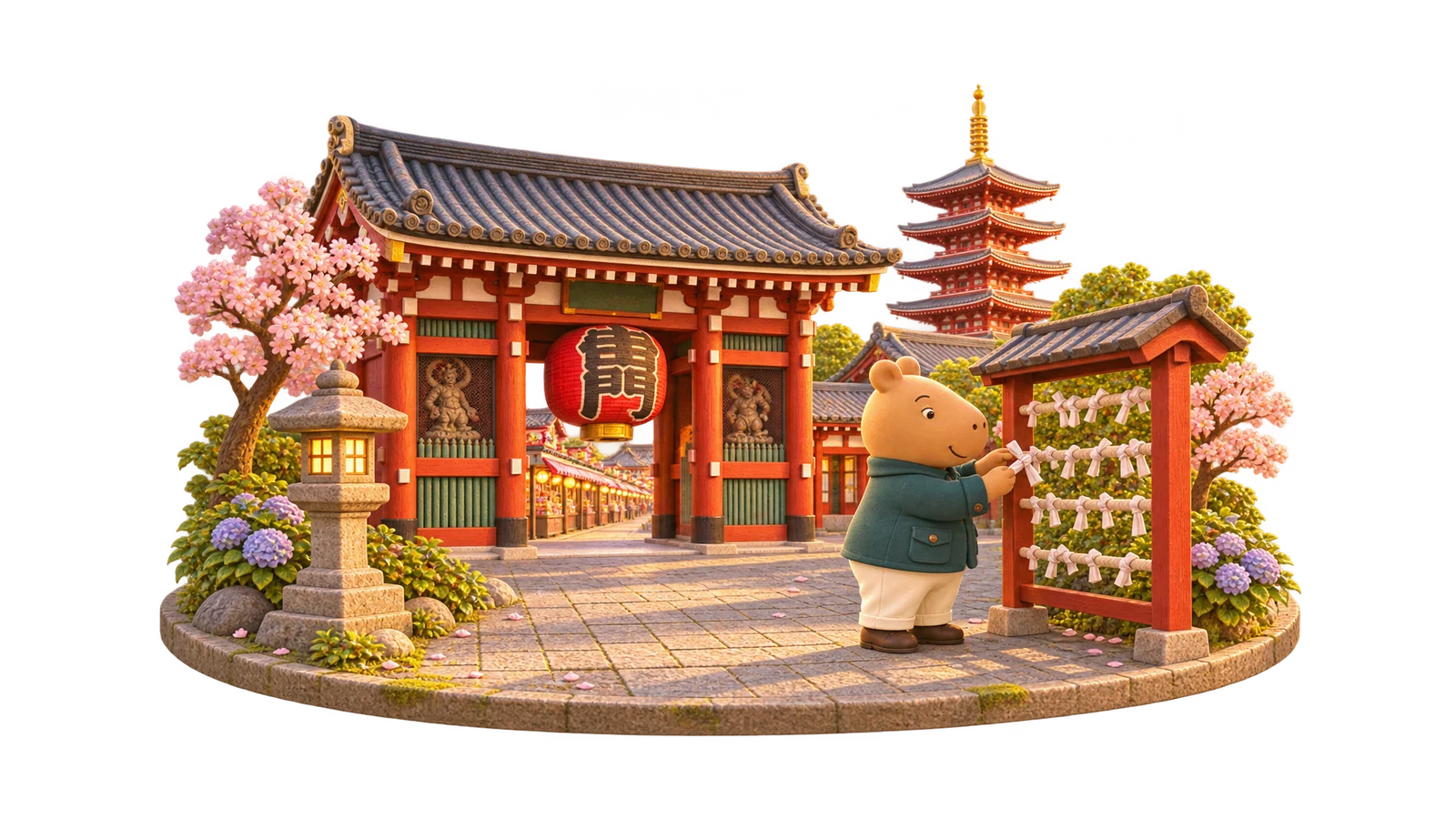
Check in once for the entire trip.
Seamless, start to finish.
A personalized live conference. One-click check-in from your email. Automatic checkout when the conference ends. Documents generated automatically.
See how it worksThe check-in area
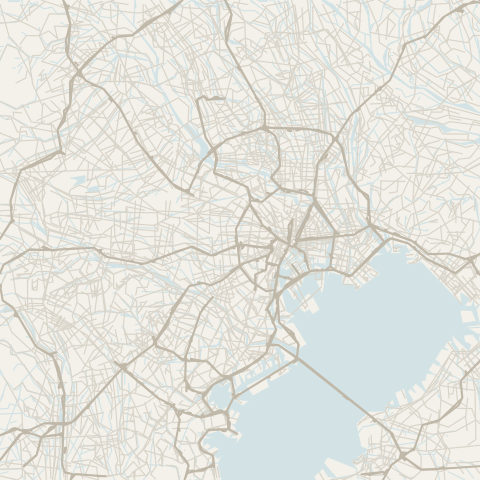
Places near the designated center
Attractions
- Meguro Parasitological Museumabout 4 miles south
- Sensō-jiabout 6 miles east
- Ueno Parkabout 5 miles east
- Tokyo National Museumabout 5 miles east
- Hama-rikyū Gardensabout 5 miles south-east
- Tokyo Stationabout 4 miles east
- Shinjuku Gyoen National Gardenabout 1 mile east
- Meiji Jinguabout 1 mile south-east
Getting here
Check in within 20 miles of the designated center.
Sessions for this region
Required regional sessions and field activities are included with every conference beyond North America.
- Radiation, disaster and emergency medicine
- History of medicine and Kampo
Site session
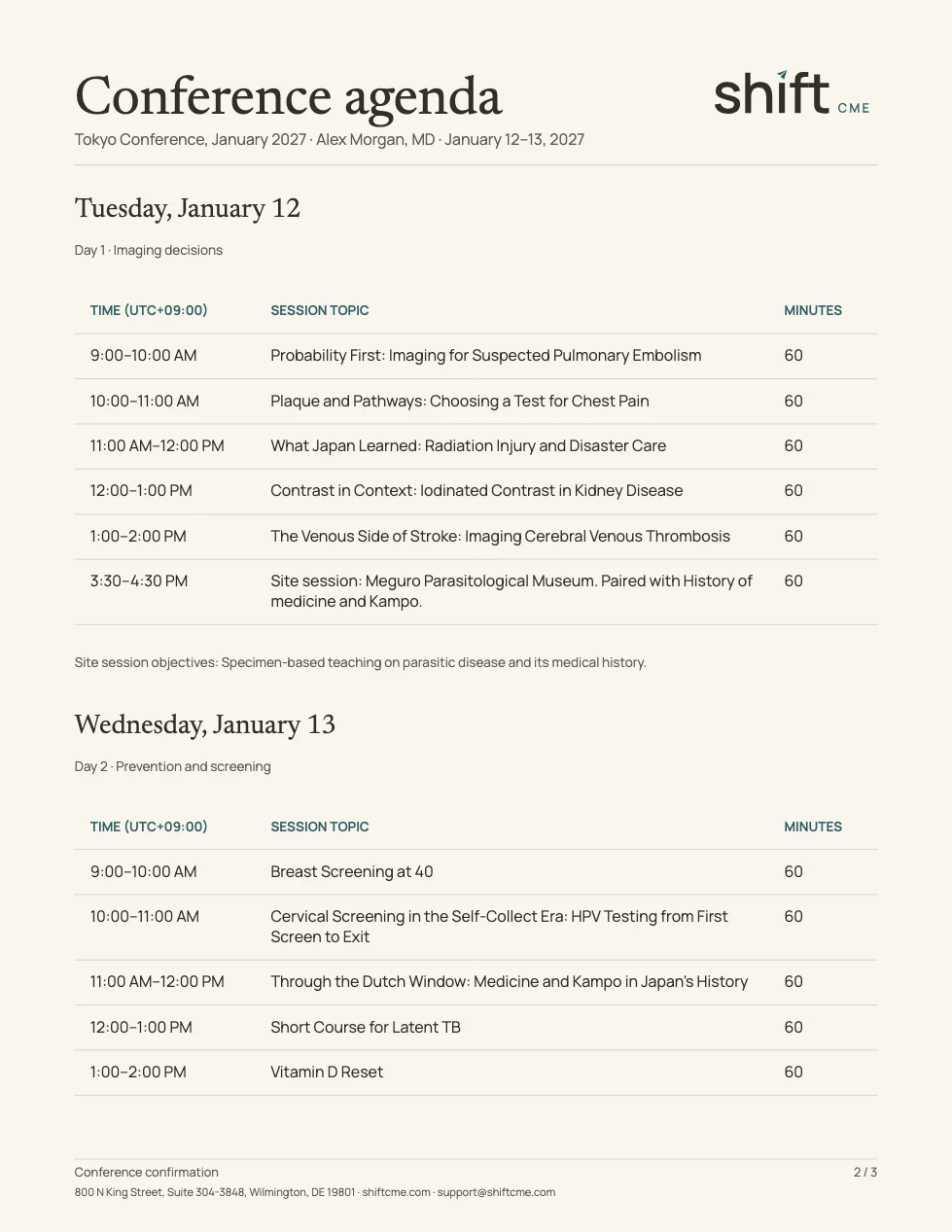
Spend the hour in the museum's permanent exhibition of parasite specimens, and discuss their place in the medical history of Japan on site.
- Venue
- Meguro Parasitological MuseumTokyo
- Session
- History of medicine and Kampo
- Objectives
- Specimen-based teaching on parasitic disease and its medical history.
- Length
- 60 minutes
Also nearby
- Yokohama and Kamakura
Documentation, done for you.
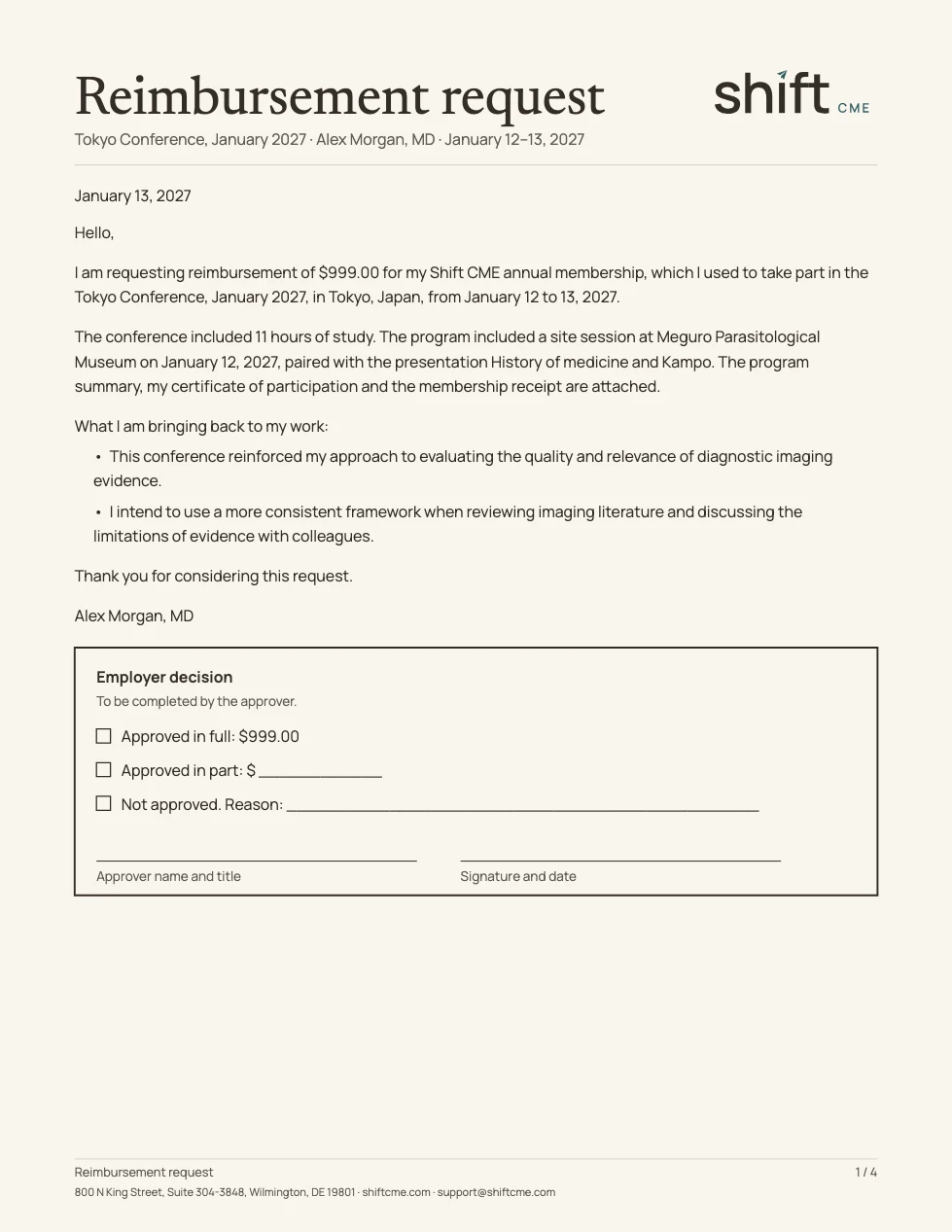
Itinerary, certificate, reimbursement letter. In your inbox.
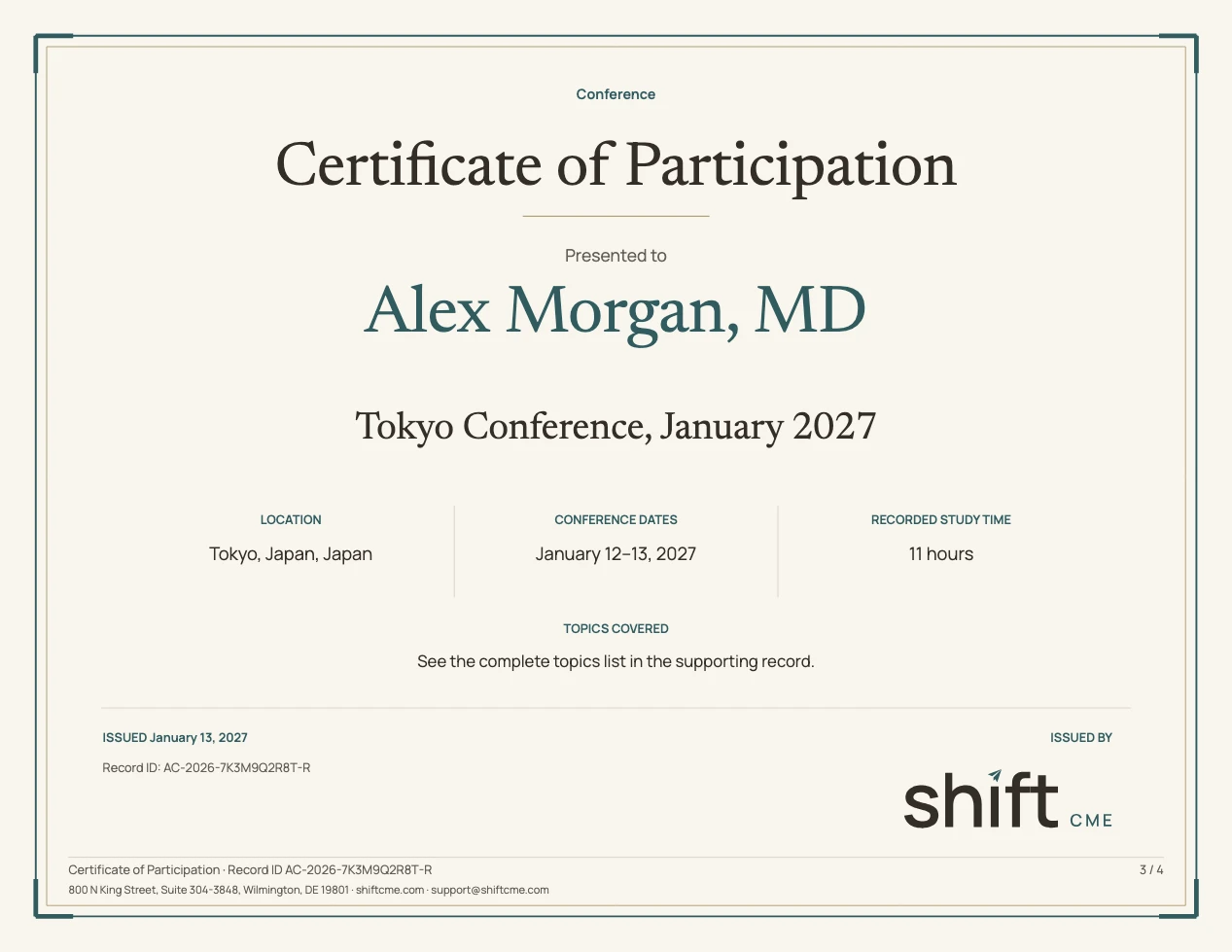
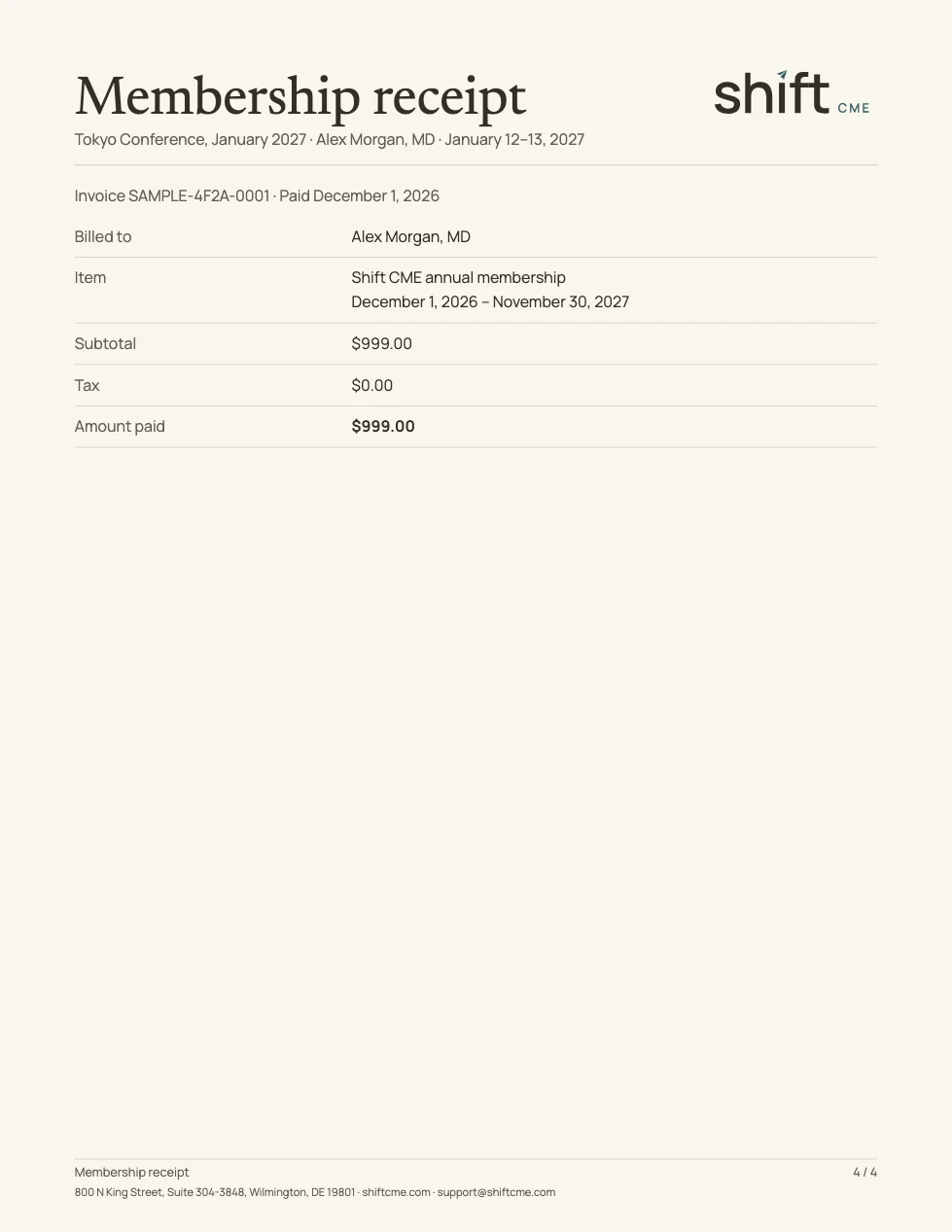
Shift CMEToday
Your Tokyo conference documents
Built around your practice.
Personalized live conferences with relevant materials.
Your conference
Tokyo
Live today · 9:00 AM – 2:00 PM
Day 1 · Imaging decisions
- Probability First: Imaging for Suspected Pulmonary Embolism
- Plaque and Pathways: Choosing a Test for Chest Pain
- What Japan Learned: Radiation Injury and Disaster Care
- Contrast in Context: Iodinated Contrast in Kidney Disease
- The Venous Side of Stroke: Imaging Cerebral Venous Thrombosis
The details.
Planning Tokyo
How it works, step by step
Choose your dates.
Make Tokyo your setting. Start any day of the year and choose 2–7 consecutive study days.
Review your personal program.
Each study day has five one-hour sessions. Swap or remove sessions before you confirm.
Go, check in and learn.
Check in once from your phone within 20 miles of the designated center. Study at your destination, then make the afternoon your own. See the Tokyo check-in area.
Watch the full How Shift works videoExplore the full three-day sample
Your program draws on licensed educational content.
Sample 3-day conference in Tokyo
IllustrativeSAMPLE CONFERENCE
A practical clinical update
Tue 12 – Thu 14 Jan 2027 · 3 study days · 9:00 AM–2:00 PM Japan Standard Time
Day 1 · Tue 12 JanImaging decisions
- 9:00–10:00 AMProbability First: Imaging for Suspected Pulmonary EmbolismAudio and slides at its scheduled time
- 10:00–11:00 AMPlaque and Pathways: Choosing a Test for Chest PainAudio and slides at its scheduled time
- 11:00 AM–12:00 PMWhat Japan Learned: Radiation Injury and Disaster CareAudio and slides at its scheduled time
- 12:00–1:00 PMContrast in Context: Iodinated Contrast in Kidney DiseaseAudio and slides at its scheduled time
- 1:00–2:00 PMThe Venous Side of Stroke: Imaging Cerebral Venous ThrombosisAudio and slides at its scheduled time
Day 2 · Wed 13 JanPrevention and screening
- 9:00–10:00 AMBreast Screening at 40Audio and slides at its scheduled time
- 10:00–11:00 AMCervical Screening in the Self-Collect Era: HPV Testing from First Screen to ExitAudio and slides at its scheduled time
- 11:00 AM–12:00 PMThrough the Dutch Window: Medicine and Kampo in Japan's HistoryAudio and slides at its scheduled time
- 12:00–1:00 PMShort Course for Latent TBAudio and slides at its scheduled time
- 1:00–2:00 PMVitamin D ResetAudio and slides at its scheduled time
Day 3 · Thu 14 JanAcute care
- 9:00–10:00 AMFailed intubation: rescue oxygenation and safe escalationAudio and slides at its scheduled time
- 10:00–11:00 AMTraumatic hemorrhage: blood strategy and definitive controlAudio and slides at its scheduled time
- 11:00 AM–12:00 PMPoisoned by Place: Mercury, Volcanic Gas and SnakebiteAudio and slides at its scheduled time
- 12:00–1:00 PMAdult appendicitis: choosing antibiotics first and reassessing safelyAudio and slides at its scheduled time
- 1:00–2:00 PMThe List That Goes Home: Medication Safety at DischargeAudio and slides at its scheduled time
Checked in 9:04 AM · location verified within 20 miles
This is a sample program. Review your available topics before you confirm.
Where to stay in Tokyo
From the temple lanes of Asakusa and the museums of Ueno Park to the gardens of Shinjuku and Hama-rikyu, Tokyo gives your time outside study a different setting in every neighborhood.
- Shinjuku
- Choose this area for a western Tokyo base. Shinjuku Gyoen is about five minutes’ walk from Shinjuku-gyoenmae Station, and the Narita Express serves Shinjuku.
- Tokyo Station and Marunouchi
- Choose this area for a central base. The Narita Express serves Tokyo Station, and the city’s tourism site groups Marunouchi with Ginza and Nihonbashi in central Tokyo.
- Ueno
- Choose this area to be beside the museums. Ueno Park is about five minutes’ walk from JR Ueno Station, and the Skyliner stops here.
- Asakusa
- Choose this area for the old temple quarter. Sensō-ji is roughly five minutes’ walk from Asakusa Station.
Afternoons, travel and weather in Tokyo
Summer heat can pass 95°F (35°C) with warm nights, the rainy season runs from June to mid-July, and autumn turns crisp and comfortable. Conferences are available all year.
Tokyo after your study day
Study days finish at 2:00 PM Tokyo time. Tokyo is a patchwork of neighborhoods, so the easiest afternoon is a single one: temples and shopping streets in Asakusa, museums and a pond in Ueno Park, or a garden walk in Shinjuku. Leave time for getting there by train and for the walk at each end.
Travel, accommodation and attraction admission are arranged separately. Your conference follows your interests; the city is simply the setting you choose for it.
Asakusa and Ueno
Tokyo’s tourism site calls Sensō-ji the oldest Buddhist temple in the capital and dates its founding to 628, although the present buildings were rebuilt after the Second World War. The Nakamise shopping street, about 250 meters long with around 90 stalls, leads from the Kaminarimon gate to the Hōzōmon gate. Asakusa Station is roughly a five-minute walk away.
Ueno Park opened in 1873 and is described as one of Japan’s first public parks. It holds the Tokyo National Museum, the National Museum of Western Art, designed by Le Corbusier, and the National Museum of Nature and Science, as well as Ueno Zoo, which opened in 1882. About 800 Somei-yoshino cherry trees line the main path, and blossom season runs roughly from late March to early April, when hundreds of thousands of visitors come each day. Nearby, Ameyoko is a market street of about 500 meters that began as a postwar black market.
Gardens and a shrine
Hama-rikyū Gardens let seawater into a tidal pond through sluice gates, so the scene changes with the tide. Bridges lead to Nakajima-no-ochaya, a teahouse on an island in the pond that was rebuilt in 1983 and serves matcha. The grounds were once a retreat for the Tokugawa shoguns and later an imperial detached palace. Shiodome Station is about seven minutes’ walk away.
Shinjuku Gyoen National Garden combines a Japanese garden with a formal garden, a landscape garden, open lawns and a greenhouse, on land that was once a daimyo residence. Alcohol and smoking are prohibited, and some areas close from time to time, so check the garden’s own notices first. Meiji Jingu is about a minute’s walk from Harajuku Station to its entrance, and its spring festival runs from late April into early May.
Neighborhoods at a glance
Tokyo’s tourism bureau groups the city by area. Central Tokyo includes Ginza, Akihabara, Tokyo Station and Marunouchi, Nihonbashi and Tsukiji. Eastern Tokyo takes in Asakusa, Ryogoku, the area around Skytree and Toyosu, while western Tokyo has Shinjuku, Shibuya, Harajuku, Aoyama and Omotesando, and Shimokitazawa.
Southern Tokyo includes Odaiba, Roppongi, Ebisu and the area around Haneda, and northern Tokyo has Ikebukuro, Ueno, Yanaka and Nezu, and Nippori. Picking one area for an afternoon keeps the trains manageable.
When to visit Tokyo
Tokyo’s tourism site describes early spring as still chilly, with short sleeves comfortable by May. Summer temperatures can rise above 95°F (35°C) and seldom drop below 77°F (25°C) after dark. The rainy season runs from June to mid-July, with humidity often above 80 percent and what the site calls relentless drizzle rather than monsoon.
Typhoon season begins in August, and September can bring storms with strong winds and heavy rain that disrupt trains and traffic. Heat above 86°F (30°C) can linger into September before temperature and humidity ease into a crisp autumn. The real cold arrives in January, when temperatures rarely drop below freezing. Use the local forecast when you plan outdoor time.
Getting to Tokyo and your study setting
Tokyo is served by two international airports, Haneda and Narita. From Narita, the Narita Express serves Tokyo Station, Shinagawa, Shibuya, Shinjuku and Yokohama, and the Keisei Skyliner serves Nippori, Ueno and Asakusa. At Haneda, stations on the Keikyu and Toei subway lines accept contactless card payment at the gates.
The map shows straight-line distances from Shift’s designated center in Shinjuku. These are orientation distances, not travel times by train. Check your exact address against the conference’s check-in area before booking.
- Destination
- Tokyo, Japan
- Travel season
- March–May and October–November
- Arrival airports
- Haneda and Narita
- Check-in area
- Within 20 miles of the center
Weather guidance helps you choose a travel season. Shift conferences are available all year.
Sources & local details
Local guidance by Shift CME, with official sources and individual review dates below. Confirm opening hours, transport and admission directly before booking. The diorama is an illustration, not a venue or included attraction.
- GO TOKYO (Tokyo Convention & Visitors Bureau) · Sensoji TempleChecked
- GO TOKYO · NakamiseChecked
- GO TOKYO · Tokyo Metropolitan Ueno ParkChecked
- GO TOKYO · Ueno travel guideChecked
- GO TOKYO · Japanese gardens in TokyoChecked
- GO TOKYO · Weather in TokyoChecked
- GO TOKYO · Getting to TokyoChecked
- Senso-ji · Overview and historyChecked
- GO TOKYO · Meiji Jingu Spring Grand FestivalChecked
- Meiji Jingu · AccessChecked
- GO TOKYO · YokohamaChecked
- GO TOKYO · KamakuraChecked
- GO TOKYO · Tokyo neighborhoodsChecked
- Narita International Airport · Rail accessChecked
FAQ
How does a conference work?
Choose your destination and dates. Your program is a set of scheduled sessions. Sessions start at their scheduled times, rather than on demand. Review the program before you confirm. See each step.
Why do I need to be at the destination?
Shift CME licenses educational content for live conferences at designated destinations. Those licenses restrict use to the conference location, so you need to be at your selected destination to participate. Sessions start at their scheduled times as part of your personalized program.
Where do I need to check in?
Select a destination from the destinations page. Check in once during your conference, within 20 miles of the destination’s designated center. Check-in is open from 6:00 AM to 10:00 PM destination time on any study day. If you haven’t checked in by 10:00 PM on your last study day, no participation is recorded. Enable browser location access; if your phone can’t confirm your location, you can confirm it yourself when you check in.
How long is a study day?
Study days run from 9:00 AM to 2:00 PM local time, with sessions starting at scheduled times. That leaves the rest of the day to enjoy your destination.
Can I change a confirmed conference?
Before you confirm, you can swap or remove sessions, or regenerate the plan. Choosing Confirm and lock itinerary locks the program. To change it after that, cancel the conference and plan a new one. Cancelled or incomplete confirmed conferences keep their confirmation.
Travel outside the North American area has different US tax rules. Ask your tax advisor.
 Orlando
 New York City
 Chicago
 Atlanta
 Philadelphia
 Phoenix
 Las Vegas
 San Diego
 Minneapolis
 Washington, D.C.
 San Francisco
 Austin
 Baltimore
 Tampa
 Miami / Miami Beach
 Boston
 Houston
 Seattle
 Pittsburgh
 St. Louis
 New Orleans
 Myrtle Beach
 Denver
 Nashville
 Virginia Beach
 Savannah
 Palm Springs
 Great Smoky Mountains National Park
 Adirondacks
 Scottsdale / Phoenix
 Portland, Oregon
 Ocean City, Maryland
 Charleston
 Santa Barbara
 Santa Monica / Los Angeles
 Gulf Shores
 Galveston
 Laguna Beach / Orange County
 Honolulu (Waikiki)
 Oahu – North Shore
 Catskill Mountains
 Cape Cod
 Zion National Park
 Grand Canyon National Park
 Monterey
 Yellowstone National Park
 Bend
 Destin
 Rocky Mountain National Park
 Yosemite National Park
 Michigan's Upper Peninsula
 Acadia National Park
 Napa Valley
 Olympic National Park
 Grand Teton National Park
 Traverse City
 Newport, Rhode Island
 Glacier National Park
 North Lake Tahoe (Truckee)
 South Lake Tahoe
 Sedona
 Canyonlands National Park / Island in the Sky
 Key West
 Seaside/30A
 Joshua Tree National Park
 Hilton Head Island
 Outer Banks
 Big Sur
 Door County
 San Juan, Puerto Rico
 Bryce Canyon National Park
 Hot Springs National Park
 Maui – Kaanapali
 Maui – Wailea
 Texas Hill Country
 Coronado / San Diego
 Columbia River Gorge
 Sanibel Island / Fort Myers
 St. Thomas
 Santa Fe
 New River Gorge National Park
 Shenandoah National Park
 Vail
 Breckenridge
 Mount Rainier National Park
 Naples, Florida
 Park City
 Amelia Island
 Rehoboth Beach
 Port Aransas
 Charlottesville
 Cannon Beach
 Arches National Park
 Death Valley National Park
 Hawaii Volcanoes National Park / Big Island
 Capitol Reef National Park
 Mammoth Lakes
 Kauai
 Sequoia National Park
 Kona / Big Island
 Badlands National Park
 Palm Beach
 Perdido Key / Pensacola
 Sonoma
 Islamorada / Florida Keys
 Paso Robles
 Saratoga Springs
 Oxford
 Grand Staircase-Escalante
 Bryson City / Great Smoky Mountains
 Marco Island / Naples
 Killington
 Mammoth Cave National Park
 Everglades National Park
 Haleakala National Park / Maui
 White Sands National Park
 Ruidoso
 Copper Mountain
 Jackson Hole
 Redwood National Park
 Deer Valley / Park City
 Steamboat Springs
 Big Sky
 Winter Park
 Alta/Snowbird
 Beaver Creek / Vail Valley
 Snowmass / Aspen
 Cashiers / Blue Ridge Mountains
 Homer / Kenai Peninsula
 Carmel Valley / Monterey
 St. John
 Jensen Beach / Treasure Coast
 Cabo Rojo, Puerto Rico
 Aspen
 Telluride
 Mount Bachelor / Bend
 Edisto Island
 Sun Valley
 Whitefish
 Stowe
 Taos
 Crested Butte
 Nantucket
 Martha's Vineyard
 Suttons Bay / Traverse City
 Moosehead Lake
 The Greenbrier (White Sulphur Springs)
 Squam Lake / New Hampshire Lakes Region
 Greer / Arizona White Mountains
 Lanai
 Mystic, Connecticut
 Indianapolis
 Iowa Great Lakes (Okoboji)
 Wichita
 Omaha
 Cape May
 Theodore Roosevelt National Park
 Cleveland
 Tulsa
 Los Angeles
 San Antonio
 Asheville
 Kansas City
 Denali National Park
 Juneau
 Anchorage
 Salt Lake City
 Louisville
 Memphis
 Portland, Maine
 Burlington, Vermont
 Dallas
 Fort Lauderdale
 Clearwater Beach / Tampa Bay
 St. Augustine
 Annapolis
 Williamsburg
 Mackinac Island
 Branson
 Chattanooga
 Kennebunkport
 The Hamptons
 Tucson
 Albuquerque
 Durango
 Mendocino
 San Juan Islands
 Kiawah Island
 Lake Geneva
 Rincón, Puerto Rico
 Vieques
 St. Croix
 Banff
 Lake Louise
 Jasper
 Calgary
 Whistler
 Vancouver
 Victoria, British Columbia
 Tofino
 Kelowna / Okanagan Valley
 Toronto
 Niagara-on-the-Lake
 Huntsville / Muskoka
 Ottawa
 Montreal
 Quebec City
 Mont-Tremblant
 Halifax
 Baddeck / Cape Breton
 Charlottetown, Prince Edward Island
 St. John's, Newfoundland
 Whitehorse
 Cabo San Lucas
 Puerto Vallarta
 Riviera Nayarit (Punta de Mita)
 Cancún
 Playa del Carmen
 Tulum
 Mexico City
 Oaxaca
 San Miguel de Allende
 Mérida
 Guadalajara
 Ixtapa-Zihuatanejo
 Huatulco
 Valle de Guadalupe
 Antigua
 Aruba
 Nassau & Paradise Island
 George Town / Exumas
 Harbour Island
 Barbados
 Bermuda
 Liberia / Guanacaste
 Arenal (La Fortuna)
 Manuel Antonio / Quepos
 Roseau / Dominica
 Punta Cana
 Santo Domingo
 Grenada
 Georgetown, Guyana
 West End / Roatán
 Montego Bay
 Negril
 Ocho Rios
 Willemstad / Curaçao
 Bonaire
 Sint Maarten
 Panama City
 Bocas del Toro
 Boquete
 Scarborough / Tobago
 Port of Spain
Tokyo. Your conference.
Pick your dates. We do the rest.